Building better models & products through research.
Research to
production.
DPO · ORPO · KTO · QLoRA · PEFT · Llama-3.2 fine-tuning · W&B experiment tracking
LLM-as-judge harnesses · Position-swap bias mitigation · Gemini-2.5-Flash judging · Custom efficiency metrics
LangGraph · Groq · Google Calendar OAuth · BERT intent classification · WhatsApp Cloud API
Pinecone · Weaviate (migrated) · Semantic memory design · Embedding-based intent matching
FastAPI · Next.js · React · Supabase · Netlify Functions · structlog · Docker
CUDA · Transformer architecture · HuggingFace ecosystem · Arduino / electronics · Python · C++
Work that has been used.
Alignment Efficiency Ratio
Comparing DPO, ORPO, and KTO under real compute and data constraints and not just win rate.
Nine primary models trained with QLoRA on Llama-3.2-1B-Instruct across 1k/5k/10k dataset scales, tracked in W&B. Judged with Gemini-2.5-Flash using position-swap bias mitigation. Introduces the Alignment Efficiency Ratio (AER) that is win-rate improvement per GPU-hour to make the compute trade-off between methods explicit rather than assumed.
Atelier
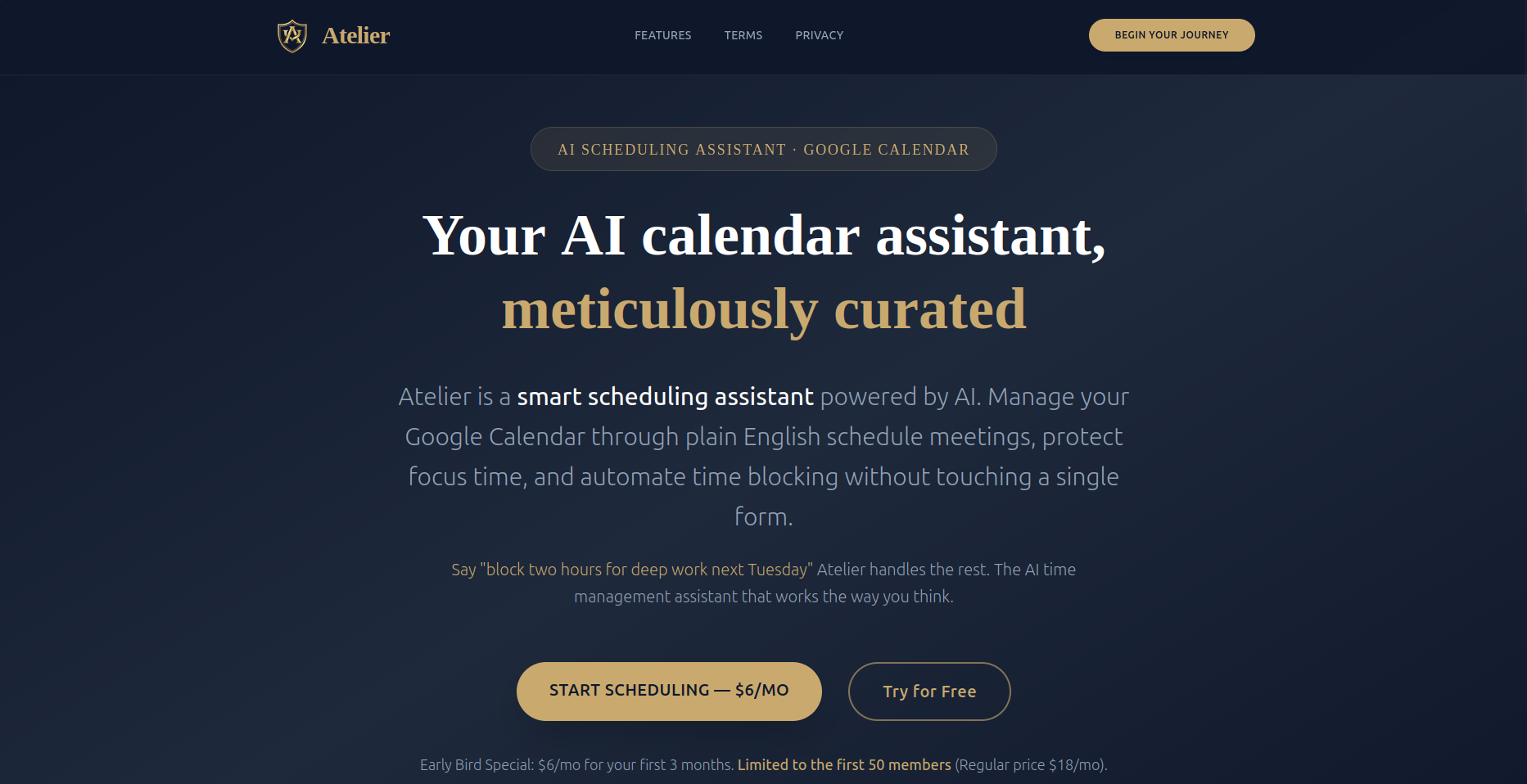
An AI scheduling assistant that reads intent and books time on your calendar for you.
A LangGraph agent classifies scheduling intent with a fine-tuned BERT model, resolves conflicts against Google Calendar via OAuth, and holds context across a conversation using Pinecone-backed semantic memory. Groq keeps responses fast enough to feel conversational.
Jobify
A resume builder that writes, structures, and scores your resume against real ATS criteria.
Jobify is an AI resume builder that scores your resume against ATS heuristics, suggests targeted improvements, and exports a polished version. It also searches jobs matched to your skills and experience. Built with Next.js, using Groq for fast resume parsing and Gemini for ATS scoring.
Konkani MT
A transformer-based translation system built for a resource-poor language pair.
A from-scratch transformer trained to translate Konkani into Sanskrit, wrapped in a Gradio interface for interactive use. Feeds directly into the same low-resource-language research thread as the ICON 2024 sentiment analysis paper below.
Published
research.
Sentiment Analysis for Konkani using Zero-Shot Marathi Trained Neural Network Model
M. Ghosarwadkar, Seamus Fred Rodrigues, P. Bhagat, A. Abranches, P.D. Korkankar, J. Pawar
An experiment applying a sentiment model fine-tuned on Marathi to classify Konkani sentiment, demonstrating that zero-shot transfer across linguistically similar languages can power sentiment classification for resource-poor languages.
READ PAPER →Comparing LLM Alignment Methods Under Constrained Conditions: A Study of DPO, ORPO, and KTO
Seamus Fred Rodrigues
Investigates preference optimization methods under low-resource constraints and introduces the Alignment Efficiency Ratio (AER) to evaluate preference gain per GPU-hour using Llama-3.2-1B and QLoRA. Found KTO the most stable and scalable method for low-data regimes.
VIEW DISSERTATION →
The work,
most recent first.
Building Atelier (AI scheduling) and Jobify (resume builder). Running AI Agent & Automation Strategy consulting. Writing on LLM alignment and agent architecture.
Compared DPO, ORPO, and KTO under compute constraints, introducing the Alignment Efficiency Ratio. Co-authored a Konkani sentiment analysis paper, published at ICON 2024.
Built a RAG-powered quiz app (Django + React), a Konkani-to-Sanskrit translation system (PyTorch + Gradio), and full-stack applications with FastAPI, Django, and React.